
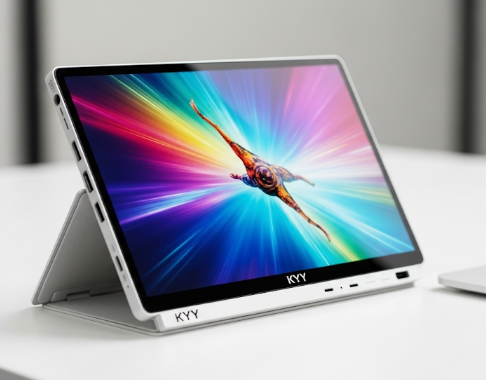

Hello friends, In today’s fast-paced world, portable monitor play a great role. Your kyy portable monitor setup should be configured properly to get the best out of it. Let’s see the information about kyy portable monitor setup as follow.
Why Pick a Portable Onkyy Monitor?
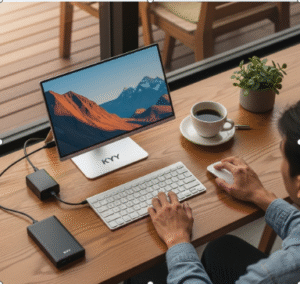
Hi Reader, For good reason, portable monitors like the Onkyy have grown in popularity. Despite being small, light and portable they have the capacity to immediately increase the size of your display area. For a larger view or a second screen for multitasking, you may connect them to laptops, game consoles, cellphones or tablets.
Essentials for Configuring Your Onkyy Portable Monitor
Hey buddy, Prior to beginning, ensure that you have:
- Your portable Onkyy monitor
- The USB-C and/or HDMI cables that are included
- If your display requires external power, use the power adapter.
- A sturdy platform on which to set your display
- Your main gadget (phone, tablet, laptop, or console)Let’s get started as soon as you have things prepared!
Step 1: Examine and Unpack
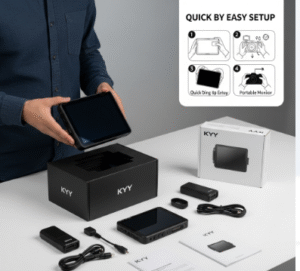
Examine your Onkyy portable monitor for physical damage after carefully unpacking it. Read the quick start instructions, examine the cables, and take off the protective films. Unintentional drops and scratches may be avoided with a tidy work area.
Step 2: Set Up the Display
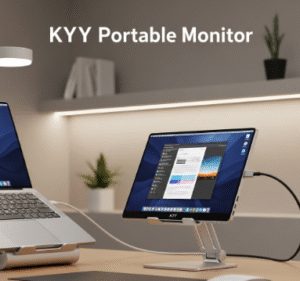
Set the monitor down on a sturdy table or desk. The majority of Onkyy portable monitors include a magnetic cover or built-in kickstand that doubles as a stand. To have the greatest viewing experience, change the stand angle. To prevent the monitor from toppling over, make sure the surface is level.
Step 3: If necessary, connect to the power source.
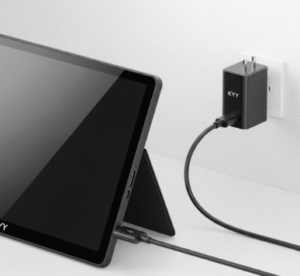
While some Onkyy portable displays require extra power, some may be powered straight from the USB-C connector on your smartphone. Connect the power adapter to the power port on your monitor and plug it into an outlet if your model needs more electricity.
Step 4: Establish a Device Connection
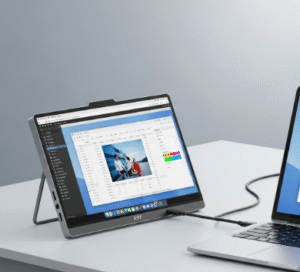
With USB-C: Video output via USB-C is supported by some smartphones and modern computers. Just insert one end of the USB-C cable into the USB-C port on your phone or laptop and the other end into the monitor. The monitor should be automatically detected by the display.
Using HDMI: Use the HDMI cable if your device does not support USB-C video output. Insert one end of the HDMI cable into the display and the other into the HDMI port on your laptop. When utilizing HDMI, you’ll probably also need to plug in the USB-C connection to power the display.
Step 5: Set Up the Display Configuration
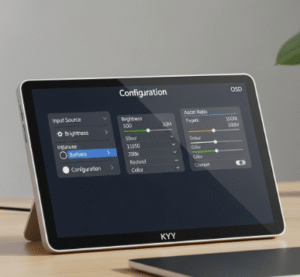
Your device should recognize the monitor on its own once it is connected. However, occasionally you’ll need to manually adjust the display settings:
- To access Multiple displays on Windows, right-click on your desktop, choose Display options, and then scroll down. Select if you want to duplicate or extend your screen.
- Navigate to System Preferences > Displays on a Mac. To adjust the location of your display, click Arrangement.
- On Android (for compatible phones): When an external display is plugged in, certain phones automatically transition to desktop mode.
Step 6: Modify Orientation and Brightness
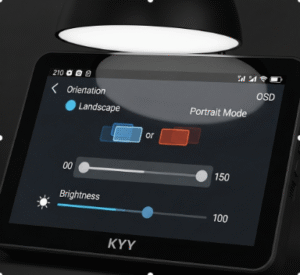
To change the brightness, contrast, volume (if it has speakers) and orientation, use the buttons on the built-in monitor. To avoid eye strain during extended work periods, make sure the screen is pleasant for your eyes.
Advice for the Greatest Experience
- Make use of a high-quality cable: The display signal may be interrupted by frayed or broken wires.
- Bring a case to prevent: scratches on your Onkyy monitor while you are traveling.
- Update drivers: For optimal compatibility, keep the graphic drivers on your laptop up to date.
- Make use of a steady power source: Examine your power connections if your monitor flickers or shuts off.
Solving Typical Problems
- No Display Found: Make sure the cords are securely plugged in. Try using a different port or cable.
- No Power: Verify the outlet and power adapter again.
- Screen flickering: might indicate that the gadget isn’t getting enough power. Make use of an outside power source.
- Low Resolution: To get the best clarity, change the resolution in your display settings.
Advantages of Using Your Portable Onkyy Monitor
A world of productivity awaits you once your Onkyy portable display is configured:
- To multitask, extend the screen of your laptop.
- Make use of it as a display for presentations.
- To play games while on the go, connect it to a gaming system.
- For a larger view when editing or streaming, connect it with your smartphone.
Concluding remarks
Hello friend, You might be surprised to learn how simple it is to set up your Onkyy portable display. Any room can be transformed into a dual-screen workstation or entertainment center with the correct connections, a power supply and a few easy procedures. You can increase your productivity anywhere you choose after spending a few minutes adjusting the settings and finding a comfortable position.
Your Onkyy portable display is your portable window to improved work, play & creativity. It is more than simply a device. Have fun multitasking!
Read more: Setup face id greyed out ❤️
FAQS:
How can I link my laptop to my Onkyy portable monitor?
Make use of the HDMI or USB-C cable that is supplied. Connect one end to the display and the other to your laptop. Attach the display to an external power source if necessary.
Why won't my Onkyy portable monitor switch on?
Verify that the power cable is plugged in correctly. Verify that the USB-C port on your device can produce video or utilize HDMI with an external power source.
Can I connect my phone to my Onkyy portable monitor?
Sure, provided that your phone (such as the Samsung DeX) has video output capabilities. Use a USB-C cable that is compatible.
Are drivers required for the Onkyy portable monitor?
The majority of models are plug-and-play, but for suggested drivers or upgrades, see the Onkyy website.
How can I change the settings on the screen?
Adjust the brightness, contrast, and volume using the controls on the display. Change the display position on your laptop by adjusting the display settings.


