Category: Household & Miscellaneous Setup

  • jumper cable setup ❤️

    jumper cable setup ❤️

    As Alex’s car refused to start on a desolate roadway in the waning dusk light, the only thing on his mind was Jumper Cable Setup. The situation seemed dismal because there was no mechanic in sight and the battery was dead, but then a friendly stranger stopped and smiled confidently to offer assistance.

    Alex understood that the straightforward yet effective jumper cable configuration wasn’t only about resurrecting a dead automobile; it was also about how little connections might give seemingly hopeless situations new life when they joined the red and black clamps in the proper order. The instruction of how to hook up a jumper cable correctly that evening evolved into more than simply roadside information; it became a memory of assistance, trust, and unanticipated friendship.

    Jumper cables: what are they?

    jumper cable setup
    jumper cable setup

    Let’s start with the fundamentals, friend. Thick, insulated wires with sturdy alligator clips (clamps) on both ends are known as jumper cables. When the battery is too weak to start your automobile on its own, they are utilized to transfer power from a functional battery to a dead battery.

    A decent set of jumper cables should have robust, rust-proof clamps for safe connections be at least 10 to 20 feet long and be constructed with thick gauge wires (four or six gauge is ideal).

    When Are Jumper Cables Necessary?

    jumper cable setup
    jumper cable setup

    Hi Reader, when your battery dies, usually from keeping lights on all night, cold weather & an old battery, you all require jumper wires. Jumper cables and a willing assist with a running automobile are your greatest friends if your car won’t start and you hear a clicking sound or see dim lights.

    Methodical Jumper Cable Configuration

    Let’s now go over how to securely set up and utilize your jumper cables:

    jumper cable setup
    jumper cable setup

    1. Park sensibly
    Make sure the cars are not touching and park the operating car near to the dead car, generally front to front. Turn off both ignitions and apply both parking brakes.

    2. Find the Batteries
    Locate the batteries by opening both hoods. Determine which terminals are positive (+) and negative (-). The negative terminal is typically marked in black with a minus sign, whereas the positive terminal is frequently covered in red or has a plus sign.

    3. Disentangle and Examine
    Untangle the wires. Verify that they are not damaged or torn. To prevent them from being stuck in engine components, lay them out.

    4. Fasten the Positive Red Clamps
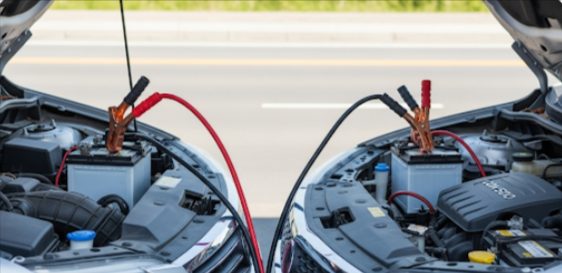
    Attach a single red clamp to the dead battery’s positive (+) connector.

    Attach the other red clamp to the good battery’s positive (+) connector.

    5. Fasten the Negative Black Clamps
    Attach a single black clamp to the good battery’s negative (-) connector.

    Attach the other black clamp to a bolt or bracket or other unpainted metal component of the deceased car’s engine block. This lessens the chance of sparking close to the dead battery.

    6. Turn on the operational vehicle
    The working car’s engine should be started and allowed to run for a few minutes. The dead battery gains some charge as a result.

    7. Try to Get the Dead Car to Start
    Try starting the dead automobile a few minutes later. Wait another two to three minutes and try again if it doesn’t start. To build up the charge, keep both cars running for a few minutes after it starts.

    8. Unplug the cables in the opposite order.
    Carefully remove the clamps in the opposite order that you attached them:

    • From the previously dead car’s grounded metal, remove the black clamp.
    • From the negative connection of the operational battery, remove the black clip.
    • From the positive connection of the operational battery, remove the red clip.
    • Lastly, take the red clamp off of the positive terminal of the recharged battery.

    9. Turn on the engine
    To allow the alternator to recharge the battery, keep the restored vehicle running for at least 20 to 30 minutes or take it for a drive.

    Safety Advice for Installing Jumper Cables

    jumper cable setup
    jumper cable setup

    Safety comes first, my friend. Here are several important safety measures:

    • When using a battery, make sure the clamps never come into contact with one another.
    • Batteries release gasses that might catch fire, so avoid smoking  lighting matches next to them.
    • Read your car’s handbook at all times.
    • Verify the terminals again to make sure the positive and negative clamps are not crossed. Certain vehicles, such as hybrids, can need certain protocols.

    What Happens If Jump-Starting Is Ineffective?

    jumper cable setup
    jumper cable setup

    If your car still won’t start, there may be a more serious problem, such as a dead battery that won’t charge, corroded terminals or a broken alternator. The best course of action in this situation is to contact an expert or have your battery checked and replaced if necessary.

    Concluding remarks

    Hello buddy! one of the fundamental skills that every driver should possess is the ability to set up jumper wires. You may save costly towing costs and hours of worry by learning it in a matter of minutes. You all always be ready for unexpected dead batteries if you have a decent set of jumper wires in your trunk.

    Read more: setup linksys extender ❤️

    10 FAQ’S:

    What is the purpose of jumper cables?

    car with a dead battery can be jump-started by connecting it to a functioning battery in another automobile using jumper wires.

    What is the ideal length for jumper cables?

    To make it easier to reach between two cars, jumper wires should ideally be between 10 and 20 feet long.

    The positive and negative clamps are what color?

    Typically, the negative clamp is black, while the positive clamp is red.

    On the dead automobile, where do I attach the black clamp?

    Instead of connecting it straight to the battery, attach it to an exposed metal section of the vehicle’s engine block.

    Before starting the dead automobile, how long should I run the operating one?

    Before attempting to start the dead automobile, let the operating car run for two to five minutes.

    Interactive Jumper Cable Setup Guide

    Interactive Jumper Cable Setup Guide

    A step-by-step, visual guide to safely jump-start your vehicle. Follow the instructions carefully to get back on the road.

    Safety First: Always wear safety glasses, ensure vehicles are not touching, and turn off both engines before connecting cables. If the battery is cracked, leaking, or frozen, do not attempt to jump-start. Refer to your vehicle’s manual for specific instructions.

    Pre-Start Safety Checklist

    Both vehicles are in Park (Automatic) or Neutral (Manual) with the parking brake engaged.
    All lights, radio, and accessories in both cars are turned OFF.
    Jumper cables are untangled, with no cracked or frayed insulation.
    You have identified the positive (+) and negative (-) terminals on both batteries.
    Progress 0/5 Steps
    1

    Position Vehicles & Open Hoods

    Park the working vehicle (donor car) close to the dead vehicle so the jumper cables can reach both batteries, but ensure the cars are not touching. Turn off both engines and engage the parking brakes.

    Open the hoods of both cars and locate the batteries. Some batteries may be under a cover – remove it if necessary.

    Donor Car (Working)

    +

    Keep engine OFF for now.

    Dead Car

    +

    Ensure all electronics are off.

    2

    Connect the RED Clamp to Dead Battery’s Positive

    Take the RED (positive +) clamp of your jumper cables and securely attach it to the POSITIVE (+) terminal of the dead car’s battery. The terminal may be marked with a “+”, “POS”, or be red in color.

    Ensure the connection is solid and the clamp is biting into the metal terminal, not just the plastic cover.

    RED Clamp (+)
    + CONNECT HERE

    Dead Battery
    Positive (+) Terminal

    3

    Connect the RED Clamp to Donor Battery’s Positive

    Now take the other RED (positive +) clamp and attach it to the POSITIVE (+) terminal of the donor car’s working battery.

    You now have a red clamp on the positive terminal of both batteries. Double-check that both red clamps are secure.

    + CONNECT HERE

    Donor Battery
    Positive (+) Terminal

    RED Clamp (+)
    4

    Connect the BLACK Clamp to Donor Battery’s Negative

    Take the BLACK (negative -) clamp and attach it to the NEGATIVE (-) terminal of the donor car’s working battery.

    This completes the circuit from the donor car. Ensure it’s a clean, metal-to-metal connection.

    +
    – CONNECT HERE

    Donor Battery
    Negative (-) Terminal

    BLACK Clamp (-)
    5

    Connect the BLACK Clamp to a Ground on the Dead Car

    IMPORTANT: Do NOT connect the final black clamp to the dead battery’s negative terminal. Instead, attach it to an unpainted metal surface on the dead car’s engine block or chassis.

    This provides a safer ground, reducing the risk of sparking near the battery. A bolt, bracket, or clean metal strut works well.

    BLACK Clamp (-)

    Unpainted Metal Bolt
    (Engine Block or Chassis)

    Next Action: Once all connections are secure, start the donor car’s engine and let it run for 2-3 minutes. Then attempt to start the dead car. If it starts, let both cars run connected for a few more minutes before carefully removing the cables in reverse order.

    Connection Complete!

    You have successfully connected all jumper cables. Here’s what to do next:

    1. Start the engine of the donor car and let it run for 2-3 minutes.
    2. Attempt to start the engine of the previously dead car.
    3. If successful, let both cars run while connected for another 3-5 minutes.
    4. Disconnect cables in REVERSE order: Black (dead car ground) → Black (donor battery) → Red (donor battery) → Red (dead battery).
    5. Drive the jumped car for at least 20 minutes to recharge the battery.

    Tip: If the car doesn’t start after a few tries, the battery may be too far gone or there may be another issue. Consider calling for professional assistance.

  • leopard gecko tank setup ❤️

    leopard gecko tank setup ❤️

    “Leopard Gecko Tank Setup” was the task I had to complete the day I brought my first gecko home. I initially believed that a straightforward glass tank would be sufficient, but I quickly came to understand that these little animals require the proper conditions to remain happy and healthy, including the proper habitat, warmth, and skins. I eventually made the ideal tank where my gecko began curiously exploring after making a few blunders and learning a lot. I learned how crucial the proper setting is in that time, and I think it’s worth sharing with those who are just beginning their trip.

    The Importance of Proper Tank Setup

    leopard gecko tank setup
    leopard gecko tank setup

    Despite their resilience, leopard geckos are totally dependent on you to provide the ideal habitat. Stress, disease, or even a shorter lifetime for your gecko might result from a badly set-up aquarium. Your gecko may live for 10 to 20 years and occasionally even longer, if the proper conditions are met!

    Selecting the Proper Tank

    leopard gecko tank setup
    leopard gecko tank setup

    A glass terrarium that is 20 gallons long is the perfect size for one adult leopard gecko. Larger tanks are preferable since they allow for more natural behavior and facilitate the creation of temperature gradients. Because leopard geckos are ground dwellers and prefer floor area over height, steer clear of tall tanks.

    Pro tip: You need a screen lid that fits snugly and securely. It keeps your gecko secure while allowing for airflow.

    Temperature gradient and heating

    Due to their cool blood, leopard geckos rely on outside heat to keep active and digest their food. Your gecko can control its body temperature on its own with the help of a suitable heat gradient.

    leopard gecko tank setup
    leopard gecko tank setup

    Essentials for heating:

    • On one side of the tank, place a heat pad or under-tank heater (UTH).
    • Keep the side temperature between 88°F and 92°F (31°C and 33°C).
    • The ideal temperature range for the cool side is 75–80°F (24–27°C).
    • It is safe for nighttime temperatures to dip to around 70°F (21°C).

    Heat rocks can burn the belly of your gecko, so never use them. To monitor the temperature at the surface where your gecko spends time, always use a dependable digital thermometer with a probe.

    Lighting Conditions

    leopard gecko tank setup
    leopard gecko tank setup

    If they consume vitamin D3, leopard geckos do not require specific UVB illumination as some other reptiles do. A low-output UVB lamp (2–5%), on the other hand, can replicate natural circumstances and can be good for their general health. Make sure you maintain a consistent day/night cycle, with around 12 hours of light and 12 hours of darkness.

    Substrate: Uses and Avoidances

    It’s crucial to select the appropriate substrate (tank flooring). Steer clear of loose surfaces like sand since, in spite of what some pet shops say, ingesting sand can result in fatal impaction.

    leopard gecko tank setup
    leopard gecko tank setup

    Options for safe substrates:

    • Slate tiles are natural nail filer and are easy to clean.
    • Reptile carpet is reusable and reasonably priced, but it requires frequent cleaning.
    • Paper towels are cheap, simple to replenish, and ideal for quarantine situations or newborns.

    Crucial Decor and Hides

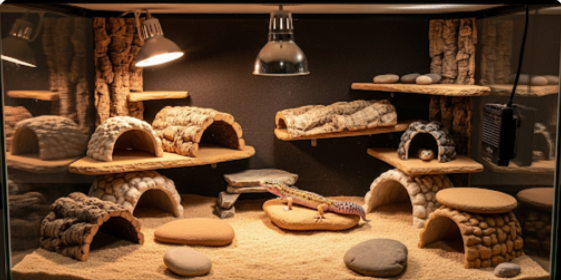
    At least three hides are required for your leopard gecko:

    leopard gecko tank setup
    leopard gecko tank setup
    • For security and digestion, warm hide is placed on top of the heat mat.
    • For a more comfortable place to relax, place cool hide on the other side.
    • Moist hide: lined with paper towels or moist sphagnum moss; aids in shedding.

    For enrichment, add branches, pebbles or reptile-safe décor, but make sure they are sturdy to avoid crushing injuries. Natural materials should always be cleaned before being added to the tank.

    Providing Humidity and Water

    leopard gecko tank setup
    leopard gecko tank setup

    Although they obtain the majority of their moisture from their diet, leopard geckos should always have access to a shallow water dish filled with clean, fresh water. Every day, change it.

    The ideal humidity range is between 30% and 40%. While too little humidity might make shedding challenging, too much humidity can lead to respiratory problems.

    Essentials of Feeding

    leopard gecko tank setup
    leopard gecko tank setup

    Although the focus of this article is tank setting, the nutrition of your gecko has an impact on how you set up their habitat, particularly with relation to calcium supplements. To prevent metabolic bone disease, dust insects with powdered calcium and vitamin D3. Additionally, keep a little calcium dish in the aquarium.

    Upkeep and Cleaning

    Your gecko stays healthy when its aquarium is clean. Every day, spot-clean the droppings, and once a month, thoroughly clean the tank:

    leopard gecko tank setup
    leopard gecko tank setup
    • Take everything out, even your gecko.
    • Use a cleaner safe for reptiles to clean the décor and skins.
    • Wash or replace the substrate.
    • Rinse everything well before replacing it.

    Last Words of Advice for Achievement

    1. Before bringing new geckos close to other geckos, place them in quarantine.
    2. Before handling, let your gecko a few days to become used to their new surroundings.
    3. Keep an eye on your gecko every day; their feeding patterns, shedding patterns & droppings may reveal a lot about their health.

    In conclusion

    Greetings Reader, Although maintaining a leopard gecko tank does not have to be difficult, doing it correctly is essential to your pet’s long-term happiness and health. Keep in mind that safe substrate, secure hides, enough heating or routine cleaning are all crucial.

    You can now sit back and enjoy watching your little reptile companion explore, hunt and live its best life since you now know how to make the perfect habitat for your leopard gecko.

    Let’s offer every leopard gecko the ideal tank they deserve if you found this information useful. Please share it with other reptile enthusiasts.

    Read more: UVA WiFi setup ❤️

    FAQ’S:

    What is the ideal tank size for a leopard gecko?

    An adult leopard gecko should be kept in a tank that is 20 gallons long.

    Should I fill my leopard gecko’s tank with sand?

    Sand can cause deadly impaction if eaten, therefore stay away from it.

    Are heat lights necessary for leopard geckos?

    Not always. For belly heat, an under-tank heater (UTH) works best, but a low-output UVB lamp can also be useful.

    What is the ideal temperature for a leopard gecko tank?

    Cool side: 75–80°F (24–27°C); warm side: 88–92°F (31–33°C); and nighttime: about 70°F (21°C).

    What is the ideal number of hides for a leopard gecko?

    Three at the very least: cold hide, warm hide, and a wet hide for shedding.

  • pool table setup ❤️

    pool table setup ❤️

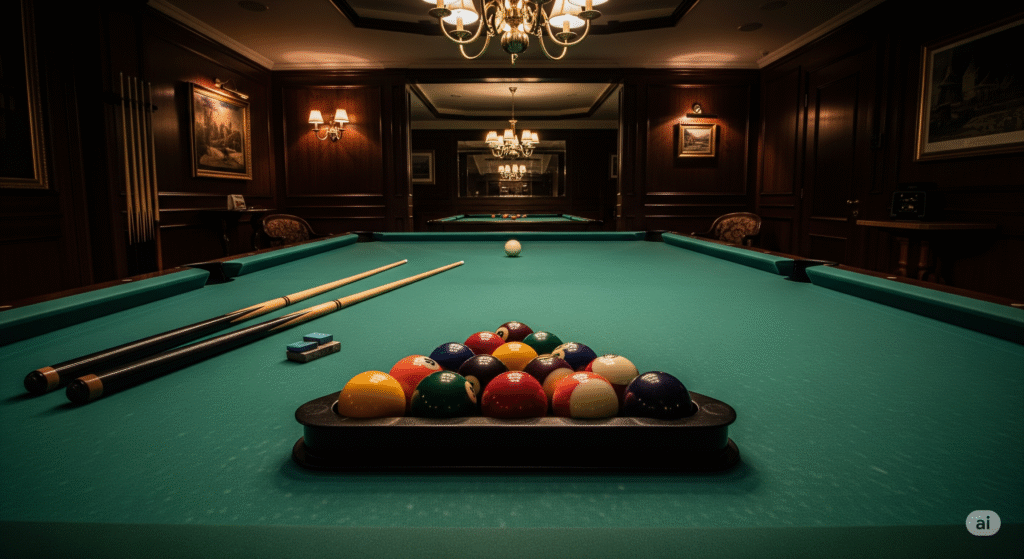
    “The first time I saw a pool table at my uncle’s house, it looked perfect — shiny green felt, polished cues, and a light hanging right above. Years later, when I bought my own, I realized it doesn’t magically come ready like that. Pool table setup is an art: levelling, spacing, and getting everything balanced. Once I set it up properly, the game finally felt like those childhood memories — smooth, fair, and fun.”

    Why Setting Up a Pool Table Correctly Is Important

    pool table setup
    pool table setup

    Hello reader, A pool table is a precise game surface that requires the proper setting, making it more than simply another piece of furniture. Unlevel surfaces, balls that veer off course & unending frustration can result from poor setup. The smooth roll, straight shots and general contentment that make every game pleasurable are provided by a properly constructed pool table.

    Selecting the Perfect Site

    Hi Reader, First things first: choose the ideal location! The space you select needs to be large enough to fit the pool table as well as players’ comfort and the ability to cue from all directions. Here’s something to think about:

    • Room Dimensions: Typical pool tables are 7 feet, 8 feet, and 9 feet in length. Generally speaking, you need at least five feet of space on all sides. For instance, the space should be at least 13 by 17 feet if you have an 8-foot table that is 4 feet wide by 8 feet long.
    • Lighting: Proper lighting from above is crucial. In order to reduce shadows and facilitate aiming, many pool players install a special pool table light.
    • Flooring: A hard, level surface is best. Carpet is OK, although it may need to be leveled more frequently.

    Setting Up and Unpacking Your Table

    pool table setup
    pool table setup

    Examine every component of your table carefully when it comes. The frame, legs, slate pieces, felt, rails and pockets are the main components of most billiard tables. First, place the frame in the desired permanent location for the table. The weight makes moving it quite difficult once you start building.

    Putting the Legs and Frame Together

    pool table setup
    pool table setup
    1. Put the frame: together by carefully following the manufacturer’s directions. Securely tighten nuts without going overboard, as this might cause wood components to break.
    2. attach the legs: Verify that the legs are securely fastened. Verify again that the frame is level and square.

    Setting Up the Slate

    Your pool table’s slate is its fundamental component. For accuracy, high-quality tables employ a three-piece slate. To install it, follow these steps:

    pool table setup
    pool table setup
    • Slate Piece Positioning: Gently place each piece on the frame. Help is needed since the slate is quite heavy!
    • Level Every Piece: Make use of a carpenter’s or, ideally, a machinist’s level. To ensure that the surface is completely level, shim as necessary.
    • Seal the Seams: To close the spaces between slate pieces, apply seam filler or beeswax. This guarantees a level playing field.

    Using the Felt

    It’s an art to stretch the felt (cloth). This is where a lot of do-it-yourself installs go wrong.

    pool table setup
    pool table setup
    • align the cloth: by smoothing the felt over the slate.
    • Glue or staple: Work outward from the center. To avoid creases or bubbles, pull the felt evenly yet tightly.
    • Cut Pocket Holes: Cut around the pocket holes with care.

    Connecting Pockets and Rails

    Attach the rails once the felt is fastened. Make certain that the cushions are snug and flush. Securely fasten the pockets. Many tables come with drop pockets or ball return mechanisms; be sure you follow the directions for your particular table.

    Last Leveling

    Examine the entire playing field one again before you play. A cue ball should be placed at different spots; if it rolls by itself, the leveling has to be changed. Shims beneath the legs can be added or removed to make minor modifications.

    Including Final Details

    To preserve your floor and improve the appearance of your game room, think about putting a rug below. Directly above the table, between 32 and 36 inches above the felt, provide adequate lighting. Keep chalk and cue racks close at hand.

    Tips for Maintaining Your Pool Table

    pool table setup
    pool table setup
    •  Clean Often: After each session, clean the rails and brush your felt.
    • Manage the surroundings: Maintain a consistent humidity and temperature in your game room. Slate or wood can get warped by drastic alterations.
    • Verify Level: After relocating the table or every few months, re-level it.

    Concluding remarks

    It takes time, accuracy & a little bit of strength to set up a pool table but the effort is worthwhile! You may have a flawlessly level table that is ready for a tournament at home if you follow my advice. Bring your pals over, rack up the balls and have a great time for hours.

    Read more: Norton.com setup ❤️

    FAQ’S:

    How much of a space is required for a pool table?

    Aim for five feet of space on all sides of your table. You’ll need around 13 feet by 17 feet for an 8-foot table.

    Does setting up a pool table need experts?

    It’s strongly advised for slate tables, though not always. They require careful leveling and are weighty.

    How is a pool table leveled?

    Make use of a machinist’s or carpenter’s level. Shims beneath the legs may be added or removed to provide the ideal level table.

    How can I keep my pool table safe?

    Keep food and beverages away, brush the felt frequently, and wear a cover when not playing.
     

    After setting up, is it possible to relocate my pool table?

    Don’t drag it! To avoid breaking the slate or frame, disassemble it first.
     

    How should a pool table be lit?

    To ensure shadow-free play, use a special overhead light 32 to 36 inches above the felt.

    What is the average setup time for a pool table?

    Depending on experience and table style, 2 to 5 hours with assistance.

    What is a pool table’s slate?

    smooth ball roll is ensured by the flat, massive stone surface beneath the felt.

    Should my pool table have a mat below it?

    Although optional, it lessens noise and protects flooring.

    How frequently should I check the level of my pool table?

    Whenever you feel like things are falling apart, or every few months.

    Pool Table Setup Assistant

    Pool Table Setup Assistant

    Your step-by-step guide to perfectly setting up your pool table based on professional recommendations and best practices.

    Room Space Calculator

    Calculate the minimum room dimensions needed for your pool table based on the recommended 5 feet of clearance on all sides.

    Recommended: 5 feet for comfortable cueing

    Furniture Placement Guide

    Visualize how your pool table fits in your room with optimal clearance for players.

    Important Note

    As highlighted in the setup guide, a hard, level surface is best for your pool table. If placing on carpet, be prepared to level it more frequently as the table may settle over time.

    Pool Table Setup Checklist

    Follow this comprehensive checklist to ensure you don’t miss any critical steps in setting up your pool table.

    Setup Progress 0%

    Pre-Setup Preparation

    Assembly Steps

    Felt & Finishing

    Setup Time Estimator

    Estimate how long your pool table setup will take based on your experience level and table type.

    Slate pieces are heavy – at least one helper is recommended

    Table Leveling Assistant

    Proper leveling is critical for accurate play. Use this tool to identify and correct leveling issues.

    Leveling Tip

    As highlighted in the guide, use a machinist’s level for the most accurate results. Add or remove shims under the legs to make adjustments, and test with a cue ball at various spots on the table.

    Leveling FAQ & Troubleshooting

    Professional Advice

    As mentioned in the FAQ, for slate tables, professional installation is strongly recommended. They have the experience and tools to ensure perfect leveling that lasts.

    Pool Table Maintenance Tracker

    Regular maintenance keeps your table in tournament-ready condition. Schedule and track your maintenance tasks.

    Monthly Maintenance Tasks

    Quarterly Maintenance Tasks

    Annual Maintenance Tasks

    Maintenance Log

    Track your maintenance activities to ensure consistent care for your pool table.

    Recent Maintenance History

    January 6, 2026 – Initial Setup
    Table setup completed using this assistant tool.

    Protection Tip

    As recommended in the guide, use a table cover when not playing to protect against dust, sunlight, and accidental spills. This significantly extends the life of your felt.

    Setup Complete!

    Congratulations on successfully setting up your pool table! Your table should now be perfectly level and ready for years of enjoyable play.

    Remember to perform regular maintenance as outlined in the Maintenance Tracker section to keep your table in top condition.

    Pool Table Setup Assistant Tool | Based on professional setup guidelines | Created 2026

    This tool is designed to complement the setup guide at setup-office.com/pool-table-setup/